
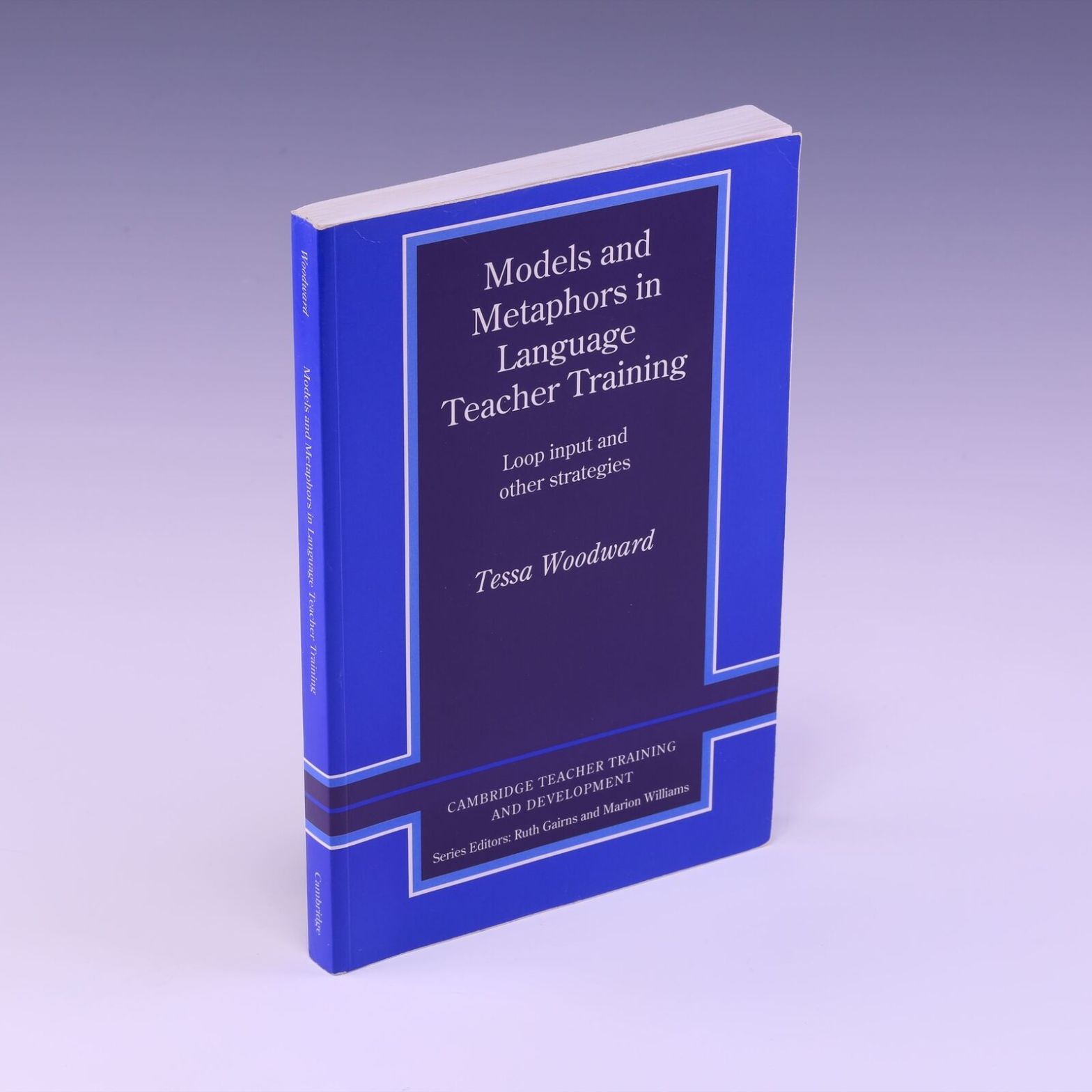
Few names have such a strong connection to language teacher education as Tessa Woodward, and it’s a bit a strange that I’ve yet to review any of her books, having read many of them throughout my career. Here I am, though, after many years of dipping in and out of Woodward’s Model and Metaphors in Language Teacher Training, writing my review of one of the more interesting books focused on becoming and developing as a trainer. As usual, I’ll provide an overview of the book, and then go into detail about what I liked/didn’t like 🙂
Three-sentence summary
Tessa Woodward’s Models and Metaphors in Language Teacher Training is one of the famous ‘blue’ books that seeks to provide the reader with an overview of different process options a trainer could use in training sessions. The books focuses heavily on loop input in the first section, but then looks at training in general, including evaluation and assessment in the second section – in short, it covers quite a lot of ground. Woodward’s book is a teacher education classic, and will provide even seasoned trainers with a few little tweaks to their training practices (or at least will make them think more deeply about their practices) – and for those just starting out in the world of teacher training, it will provide plenty of practical ideas for the training room.
Three takeaways
“Of all the different models you could use when training teachers, loop input is just one. Loop input is, in a sense, a metaphor: some of the existing connotations in the word ‘student’ are applied to something that does not normally have that surface meaning, i.e. a trainee. Parts of a student’s experience are blended with parts of a trainee’s needs. A thread is wound from one bobbin to another.”
Woodward, 1991, p.132
- Loop input has so much to offer: Loop input is essentially getting teachers to experience the thing the session is focused on. So, if the aims of the workshop are to develop teachers’ abilities to teach reading lessons, then the trainer might use a full loop and have teachers act as learners in a reading lesson, with the reading texts being centred on teaching reading skills. So, what does this offer teachers? Well, it allows them to experience to an extent how learners might feel (or see what they might do) in X situation. Furthermore, it allows provides them with an experience to analyse. The analyse part, however, is probably the most important part of the loop – teachers need to have a time where they analyse what occurred. But what about the benefit for the trainers? Well, it allows the trainer to model good of bad practice, it can allow the delivery of content (e.g., information of different types of reading sub-skills) in an interactive manner.
“Establishing a metaphor at the start of a training course can be useful for many reasons. First it can make clear a trainer’s assumptions about a teaching, learning and training. It can provoke thought and start the course off with a clear image and a clear statement of what a course participant can expect from the course. As the course progresses, reference can be made back to the metaphor or image, which can create a sense of coherence. The establishment of a course metaphor can, in turn, lead to decisions being made about which types of process options to employ, what type of material to use, and so on, in order to set up a coherence, an echo, throughout the course within he spirit of the metaphor.”
Woodward, 1991, p.155
- Metaphors are extremely useful in eliciting teachers’ values, attitudes and beliefs: How do you view the course book? Is it a ball and chain? A springboard? A holy book? What I’ve just done is present you with a set of metaphors for the course book, and you’re probably thinking about which of these best fits your view of the course book. In essence, the metaphor is helping make explicit your beliefs about the course book. This is of course a very famous and well-used example of metaphors in language teacher education, but it highlights why they are beneficial in the training room.
“Parameters act like clefs, staves and bar lines that give shape rhythm to music. They are the reality of our training lives and can make things interesting as well as impossible at times. They make thoughts and creative solutions necessary, and we all tend to view them in different ways.”
Woodward, 1991, p.163
- Training is a complex endeavour, but by analysing and taking into considering parameters, we can approach the training with a greater chance of success: Below I’ve included a picture of the parameters put forward by Woodward (she does mention that these are the main parameters, and as such we can assume that there may be others that are not mentioned). Woodward is definitely not prescriptive, and invites the reader to identify their own parameters – but I found the list that she put forward quite useful (and it covers a lot of ground). Her main point for creating this list (although it is presented as more of a group to provide the idea that no one parameter is more important than another in general) is to stress the importance of exploring the context, the people, etc. involved in the training, because without this then we might miss something of importance and our training might not be as effective as it can be (I’ve read between the lines here, but I feel that this is what Woodward is getting at).

What I liked
- Provides plenty examples of loop input: For those looking to deepen their understanding of loop input (and many other concepts), this book does really well at providing examples. The first few chapters in the book are devoted to exploring training and loop input, and then the rest of the chapters in Part 1 explore one area of teaching and provide an example of loop input with that theme (e.g., classroom management). I found this quite useful.
- Is aimed at both early-career teacher educators, but will benefit more seasons educators also: I’ve read a fair few books, and have been training for a while now, and I still got loads out of the book. It will push you to think deeper about certain topics (e.g., parameters about training), and I really enjoyed that. This being said, I think someone new to teacher education could quite easily pick this up and being able to process and use most of the content and ideas quite easily.
- Is not all ‘text’ – Woodward provides plenty of visual scaffolding which really helps: Woodward provides some brilliant visual scaffolding throughout the book in the form of mind maps, diagrams, pictures, etc. If I’m honest, I’ve never really read another book like this in that regard, and I really appreciated the visuals as they helped me see things in different ways (I feel we often view topics in linear ways too much, and this book does a lot to break that).
- Covers a lot of ground: So, whilst the first part of the book focuses heavily on loop input, the chapters all focus on different areas of teaching and as such the reader learns about a lot of different things a long the way. I’ll forgive Woodward for not exploring more task-based methodologies and more SLA given that this was written in 1991, but the book does really well in presenting a lot of practical teaching theory to the reader. Furthermore, in terms of the ‘basics’ of evaluation of training and looking at what’s involved in the training room, this book does extremely well.
- Provides plenty of scope for the reader to include their own ideas: In pretty much every chapter, Woodward invites the reader to include their own ideas, create their own loops, or think about their own context. I’m a big fan of this in books as it models what we should be doing in our classrooms and the training room!
What I didn’t like
This book provides a lot, but there was one part that I found difficult to read. The first part of the book is laid out really clearly, and then the exploration of the topics is brilliant (it doesn’t go really deep, but then again it’s a book aimed at covering a lot of ground, so you wouldn’t expect it to). However, when I got to Part 2 I felt like the whole book changed in terms of layout and readability – in short, it felt quite disjointed. Considering how much value this book brings, I think this is a minor point, but it is something that remained on my mind pretty much through the majority of the second part.
Who should read this book?
- Early-career teacher educators: If you’ve just started out in language teacher education and are involved in delivering workshops, then this book will be super handy. It would be good to read it with another trainer so that you can bounce ideas of each other, but even reading it alone will be beneficial.
- Experienced trainers: Yes, even experienced trainers will get something out of this book. If nothing else, it will help make clearer the intricacies of loop input!
Applying to practice
So, in this section I talk about how I might apply what I’ve learnt to my practice, but the reality is that I’ve been using this book for many years now and I feel that it has impacted my practice significantly already. I will, however, talk about one thing that I would like to do regarding metaphors:
- Using metaphors with teachers I coach/mentor: The start of every coaching or mentoring relationship often focuses on establishing what the relationship will be like, who will do what, etc. Normally, I ask questions to explore teachers’ thinking and then we get to an agreement. What I would like to do, though, is get them to think of a metaphor for the coaching/mentoring sessions and work from there – this will help me see how they perceive the sessions before we even get to the agreement.
Final notes
Tessa Woodward’s Models and Metaphors in Language Teacher Training has been a regular visitor to my desk over the last few years. It has made shaped how I plan workshops, and even played a pivotal role in my assignments for the NILE MA Trainer Development module. In short, I have found this book valuable, and I trust that you will as well. Having said this, I’d love to hear your thoughts. What were your takeaways? What did you like/dislike? Do let me know! 🙂
Book details
Book title: Models and Metaphors in Language Teacher Training
Author: Tessa Woodward
Pages: 247
ISBN: 9780521377737

 SPONGE ELT