

‘Article Notes’ is a set of blog posts in which I write down my notes about articles that I read. These notes are not meant to be ‘academic’ or ‘formal’; rather, they are my ramblings and immediate thoughts in reaction to the content I read. I’ve written them up to help me remember the article, and to share my thoughts with those who are interested. I welcome your feedback and comments!
Reading Room 2
So, based on the success of Reading Room 1, we decided to do another, this time using Fred Korthagen’s very provocative and insightful article Inconvenient truths about teacher learning: towards professional development 3.0. Whilst we had less people (thanks KD!), we had an absolutely brilliant discussion about our experiences in training, our contexts, and what implications Korthagen’s article (and research, opinions, etc.) can be drawn.
Anna Hasper was kind enough to come up with the pre-reading questions once again, and so I’ll follow the same format as last time. That is, I’ll go over the pre-reading questions, my summary and notes from the article, and then included some reflections on the Reading Room experience.
Pre-reading questions
What are your definitions of the words theory and practice?
Hmm I think there is a simple way of answering this, and then a much more complex one. Let’s go the simple one: theory is that which can be learnt from ‘learned’ others or artefacts such as books, articles, etc., whereas practice is what teachers actually do in their classes, which may or may not be informed by theory. If, for argument’s sake, we were to take a more complex view, here are some of the points we could explore:
- A lot of theory is ‘created’ by experts in fields and then passed down to practitioners; however, now we know that research has begun to take the practitioner perspective first, and so there is now much more theory that is ‘created’ bottom-up. If the theory is created by the practitioner, is it still perceived the same by both researchers and teachers?
- We know that teachers have their own personal theories of teaching, which are often shaped by their prior experiences, interactions with learners, and is highly contextual based. Does this ‘theory’ count as theory?
Do you feel that there’s a huge gap between these in light of teacher education?
Yes, but for a few different reasons. One, much of theory created in the past (now also, but less in my opinion) was created and advocated by researchers who had little to no experience in the classroom. As such, there was, and still is, a hesitancy from practitioners to utilize the theory. A common response is “Try doing that in my class!”.
Two, teachers very often have little time to engage in research and find out about the latest findings or implications for practice, and then actively implement these in their classes. Teachers are teaching upwards of 20 hours a week, plus planning, plus CPD programme, plus their own personal lives. So, teachers often get a bad wrap for not crossing the theory-practice bridge-gap, but who can blame them? And perhaps a more important questions should be: is it their responsibility?
So, whose responsibility is it? Well if we go back to that teacher response “Try that in my class”, I feel that we can learn a lot from this. Teaching is a highly contextualised act, and as such those managing and training in that context should be leading efforts in bringing the theory-practice gap. What do I mean? I mean that teacher educators and academic managers should be engaging with research relevant to their context, and providing relevant insights to individual teachers based on their needs at any given time. There is a lot more I could say here, but for now I’ll leave it there 🙂
How do you feel about the statement below?
“Traditionally, in analysis of this problem [the gap between theory and practice], the focus has been on the question of how practice can become better linked to theory. Only relatively recently have practitioners and researchers considered the option of reversing the order and link theory to practice.“
Korthagen, 2017, p.387
I think this reflects a lot of what I’ve read about the theory-practice gap, although I do know that a lot of research is now based in practice. That is, many researchers seek out real classrooms in which to conduct research. So, I think the paradigm is shifting, although it has a long way to go.
Summary and notes
Korthagen writes that there are 4 versions of professional development that occurs in teacher education. I’ll summarise these here:
- Professional development 1.0: This is the theory-practice approach, and is an approach that has remained ever present even though “a variety of studies have shown its failure in strongly influencing the practices of teachers” (Korthagen, 2017, p 388). For those that read my articles note for Diaz Maggioli’s (2011) Four perspectives in teaching teachers, this connects to the read-and-learn perspective.
- Professional development 1.1: Closely connected to 1.0, professional development 1.1 tries to “make theory more meaningful to teachers” (Korthagen, 2017, p.388) through the provision of examples. So, we still have the theory, but it is coupled with examples in the form of videos or live lessons. Diaz Maggioli (2011) would label this look-and-learn.
- Professional development 2.0: Whereas 1.0 and 1.1 are based in theory, 2.0 is almost a knee-jerk reaction, placing the emphasis primarily on practice. So, before we started with theory, now teachers are thrown into practice “hardly without any preparation” (Korthagen, 2017, p.388), and are supported in their development through the use of portfolios and reflection activities. But, whilst this did well in preparing teachers for the classroom, Korthagen (2017, p.388) writes that an issue with this approach is that fails to “connect practical experiences to theory”. Thinking about Diaz Maggioli’s (2011) perspectives, we might call this think-and-learn, although I feel that Korthagen perhaps is stressing that there is less theory in 2.0 than Diaz Maggioli writes in this perspective.
- Professional development 3.0: So, what about 3.0? Well, this is an approach to professional development in which the “professional and personal aspects of teaching are intertwined” (Korthagen, 2017, p.389). Towards the end of the article, Korthagen presents a diagram representing how teacher learning takes place (see below). In effect there are three components: Practice, Theory, and Person. Professional development is 2.0 plus the ‘Person’. This connects somewhat with Diaz Maggioli’s (2011) participate-and-learn perspective, through which the teacher becomes a teacher.
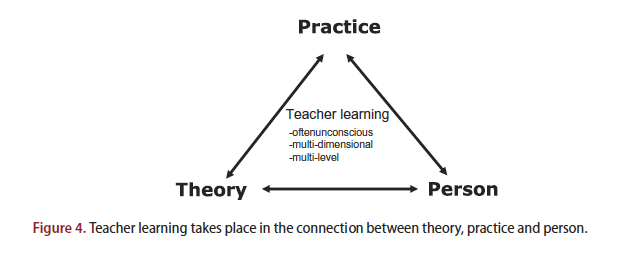
So, then, what does professional development 3.0 look like? Well, Korthagen gives us some ideas:
“Although a lot of teacher behaviour and learning seem to take place unconsciously, in-depth reflection is an important instrument in establishing fruitful connections between practice, theory and person.”
Korthagen, 2017, p.398
- Core reflection: Korthagen presents his ‘Onion model’ (see below), and writes that we need to engage teachers in reflection; however, this should occur at a meaning level (i.e., meaning-oriented reflection) and less at an action level (i.e., action-oriented reflection). Regarding the Onion model, this means that the reflection needs to occur at the inner layers – connecting what has occurred to underlying beliefs, values, and core qualities. Here Korthagen infers that action-oriented reflection is not very effective, and to an extent I agree, although I do feel that reflection that looks at practical responses can be quite useful to certain teachers (e.g., early-career teachers), although I do agree with him fully in that we need to help teachers connect their practice to theory and their inner core qualities.

“Although it seems an attractive idea to introduce evidence-based theory in education and ‘train’ teachers in the use of this theory, there is much evidence that this does not work. Educationalists need a more realistic vision, which means that not only practice, but most of all the human beings working in the contexts of their scholls become the starting point for change processes. Otherwise, the school context will have an influence of its own, often counterbalancing attempts to change teacher behaviour.”
Korthagen, 2017, p.399
- Focus on developing a supportive social learning environment to counter any negative socialising effects: In Martin East’s (2022) Element Mediating Innovation through Language Teacher Education he wrote about teachers who had completed courses on TBLT and then went to their placements in schools and came against more traditional viewpoints from other teachers, and as a result had issues implementing TBLT or dropped it altogether. This connects with the concept of socialisation; that is “habitual patterns in schools [having] a strong influence on new teachers entering the school” (Korthagen, 2017, p.390). What this means for teacher education, then, is that we need to really consider the context in which learning takes place, and the factors that might influence (positively and negatively) the implementation of ideas.
“This implies that the outcomes of learning processes in teachers cannot always be predicted, as each individual teacher should be taken seriously and the process should build upon his or her concerns, gestalts, personal strengths and mission, within the context of their actual work. Professional development 3.0 can thus never be a one-shot approach, or follow a ‘one solution for all’ strategy.”
Korthagen, 2017, p.400
- Step away from the one-size fits all approach, and implement a differentiated approach to teacher education that develops the teacher and the person: This is something that many of us already know, but often find difficult to implement. This being said, I think the onus is on language teaching organisations (LTO) to support teachers in their development from a bottom-up perspective; that is, rather than prescribing ‘training’ with the needs of the LTO in mind, we need to take a more bottom-up approach and work with teachers’ needs and wants, whilst at the same working with the LTO’s needs. I know this is easier said than done, but if we are really looking for effective teacher education, I think it is a must. I would wager that Korthagen would agree. On a side note, I was reading a short blog post by Tom Godfrey who was speaking about how teacher education in ELT is on the wrong track – I highly recommend checking it out.
“An inconvenient truth may be that effective professional development 3.0 is first of all value-based, which means that is starts from what practitioners themselves value in their own work. It is also much more open-ended, and to a. certain degree more unpredictable than traditional approaches, os it often requires deep cultural change.”
Korthagen, 2017, p.400
- A deeper exploration of values, attitudes and beliefs: The literature is pretty clear on the idea that for teacher learning to occur, teacher values, attitudes and beliefs need to be taken into account. So, in practice we should be helping teachers uncover these beliefs, help them understand themselves as teachers and perhaps even ‘learners’.
“The studies on core reflection cited above show the need to address the whole person in efforts to bring about professional learning and also that this can lead to the framing of deeply ingrained limiting beliefs and to new and effective behaviour in the classroom.”
Korthagen, 2017, p.400
- Address the whole person: This means going deeper into who the teacher is. What are their aspirations? What drives them? What learning experiences do they bring to their teaching – and how is this influencing them? How might we do this? Dialogue is one answer, and lots of it probably. We can also use Korthagen’s Onion model as a guide for the levels of reflection we can aim for.
This article really connected with me on many different levels, and I think that what Korthagen is writing about is extremely important as our industry moves forward and looks to become more professional. I don’t think that it is easy to implement professional development 3.0, but I do think that it is something to aim for, and I think it has a lot to offer to both pre-service and in-service second language teacher education.
Reading Room Reflections
In the reading room, I was joined by Khanh-Duc, who some of you will remember from Sponge Chats. We both went pretty deep in reflections in this chat, and as it was just the two of us we could go off on some pretty wild tangents. We started by reflecting on our own experiences as teacher-learners, and then analysed our contexts now in terms of what type of professional development approach is taken. It was quite interesting to see the differences.
KD and I came to the conclusion that these approaches to professional development, from 1.0 – 3.0 are all used around the world, but perhaps there is still a focus on 1.0 – 2.0, depending on the context you are in. For example, many university-level courses don’t actually engage teachers in teaching until the final year of study (professional development 1.0/1.1), whilst pre-service short course like Celta and CertTESOL throw teachers into the deep end almost immediately, and don’t provide teachers with much theory at all (professional development 2.0).
KD and I are on the TTEdSIG committee and thought that it might be a good idea to explore this further with teacher educators at next year’s IATEFL PCE – if you’ve enjoyed this article notes, then you might consider coming along 🙂

 SPONGE ELT
1 Comment